
Articles
Product updates, feature announcements, and video workflow tips.
VideoTagger
5
How Far Can AI Take Video Management? VideoTagger's Design Philosophy and Roadmap
Hand your video library entirely to AI and you trade away the one thing that matters: trust. Here is why VideoTagger pairs AI candidates with one-click human confirmation — and where the roadmap goes from here.
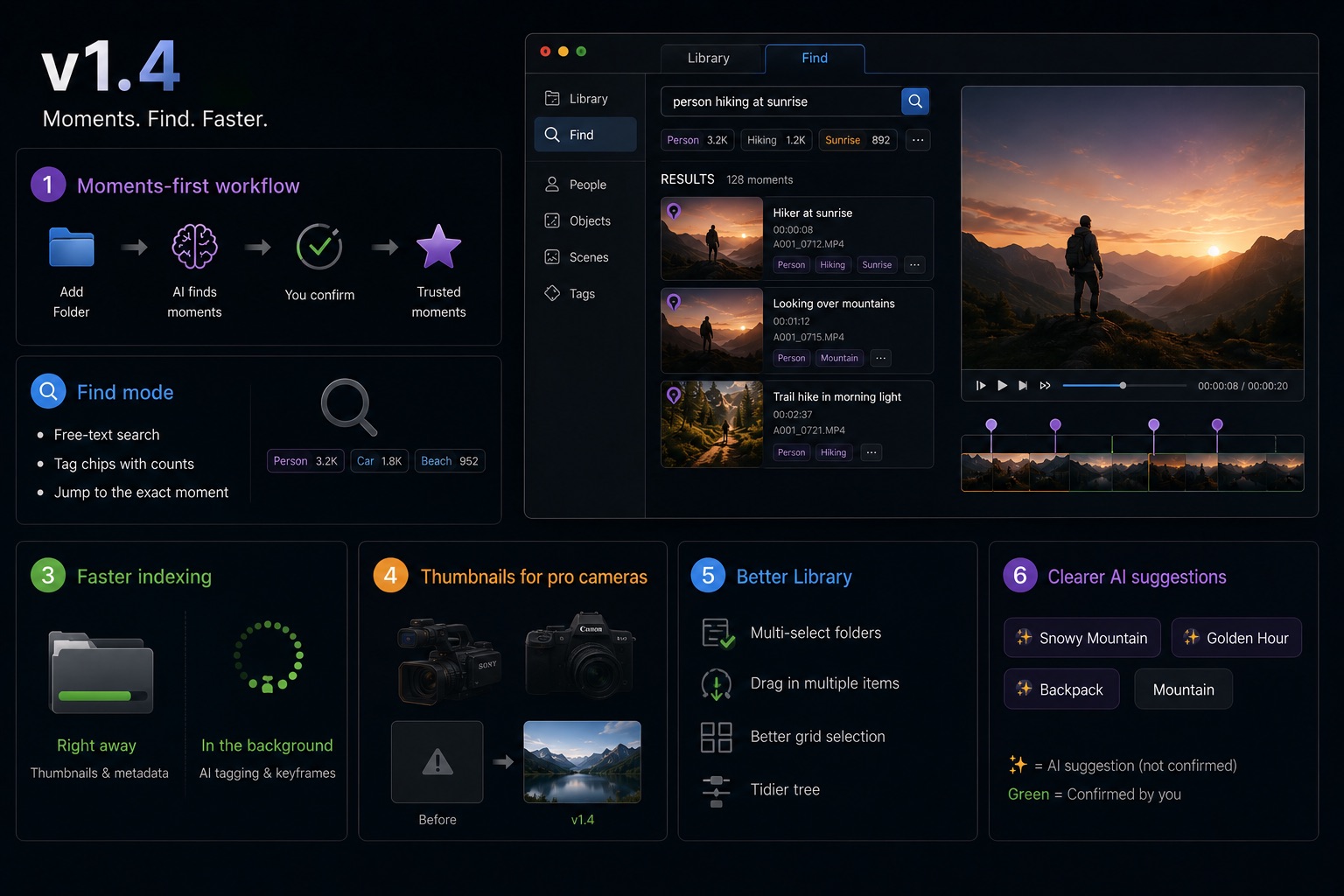
What's New in v1.4: Moments, Find Mode, and Faster Indexing
VideoTagger v1.4 rebuilds the main flow around Moments, adds a dedicated Find workspace, makes indexing fill the grid instantly, and brings thumbnails to pro camera footage like HEVC 4:2:2 10-bit.
Building a Tag Vocabulary That Matches Your Work
AI tags get you 80% of the way. The last 20% — the part that makes your library actually searchable for *your* projects — comes from the vocabulary you build on top. Here is how to build one that lasts.
Why VideoTagger Runs Entirely on Your Device
Most AI video tools send your footage to someone else's servers. VideoTagger doesn't. Here is what on-device AI actually means for your privacy, your speed, and your monthly bill.
Manage Your Videos Effectively — Introducing VideoTagger
Folders and filenames stop working once your video library grows. VideoTagger indexes the moments inside your videos so you can find, collect, and reuse them in seconds.
Video Knowledge
11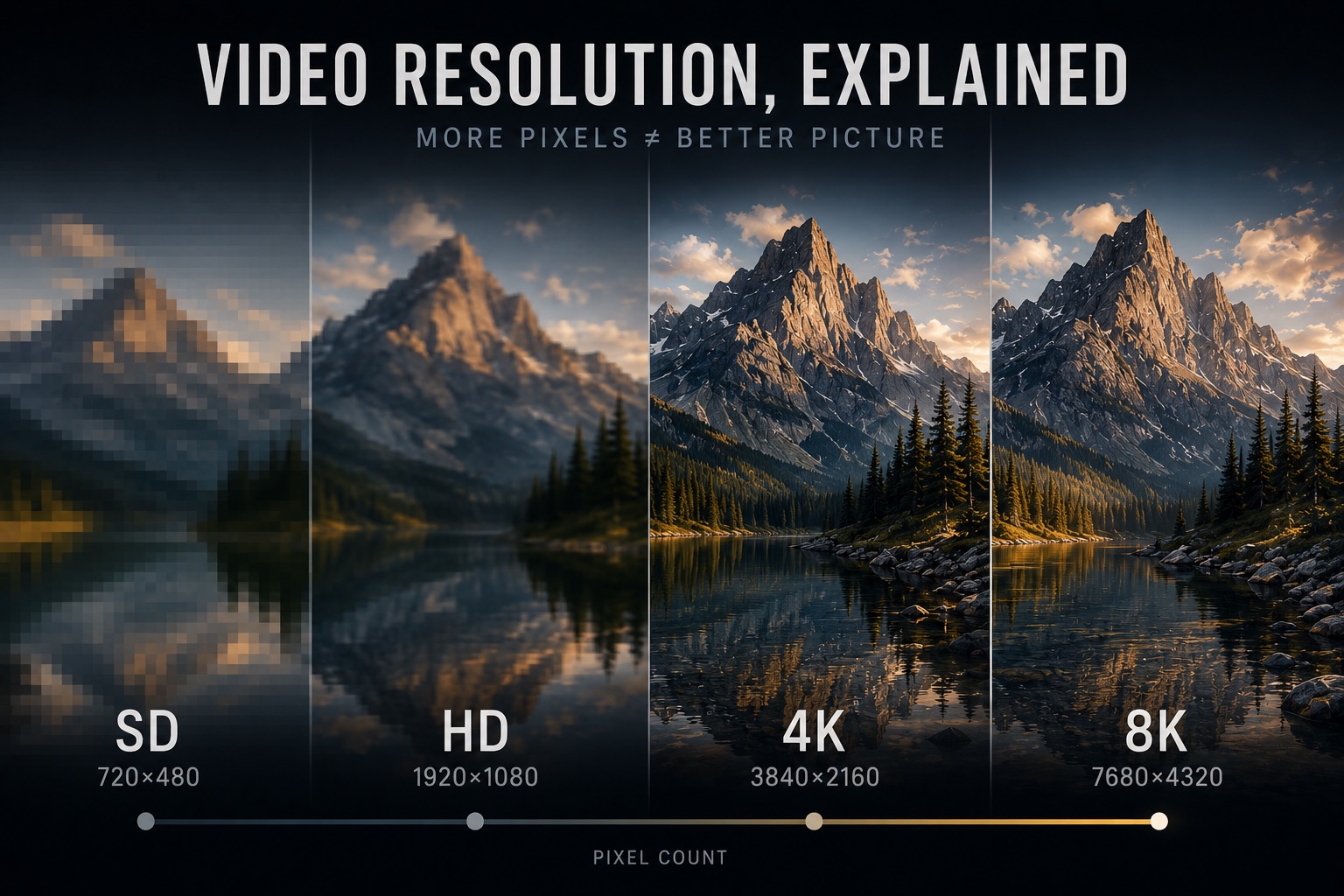
Video Resolution, Explained — SD, HD, 4K, 8K, and What More Pixels Actually Buy You
"4K" is on every camera box and TV shelf, but resolution is the most misread number in video. Here's what the tiers from SD to 8K actually are, why DCI 4K and UHD aren't the same thing, why more pixels don't guarantee a sharper picture, and when they genuinely pay off.
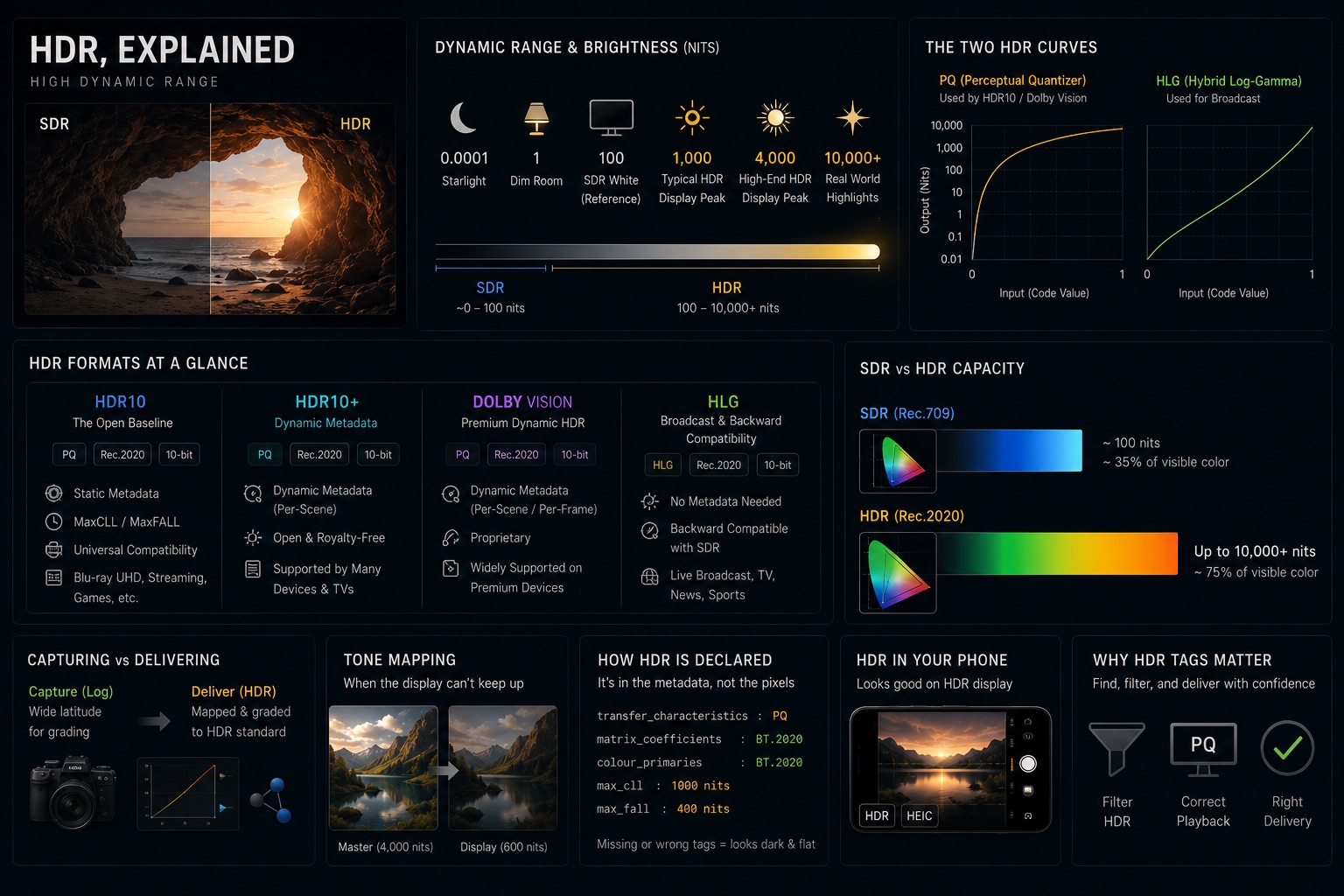
HDR, Explained — HDR10, Dolby Vision, HLG, and What "High Dynamic Range" Actually Means
HDR is sold as "brighter, more vivid" — but that marketing hides what's really going on. Here's what dynamic range actually is, why HDR needs PQ or HLG curves and 10-bit color, and how HDR10, Dolby Vision, and HLG differ in one sitting.
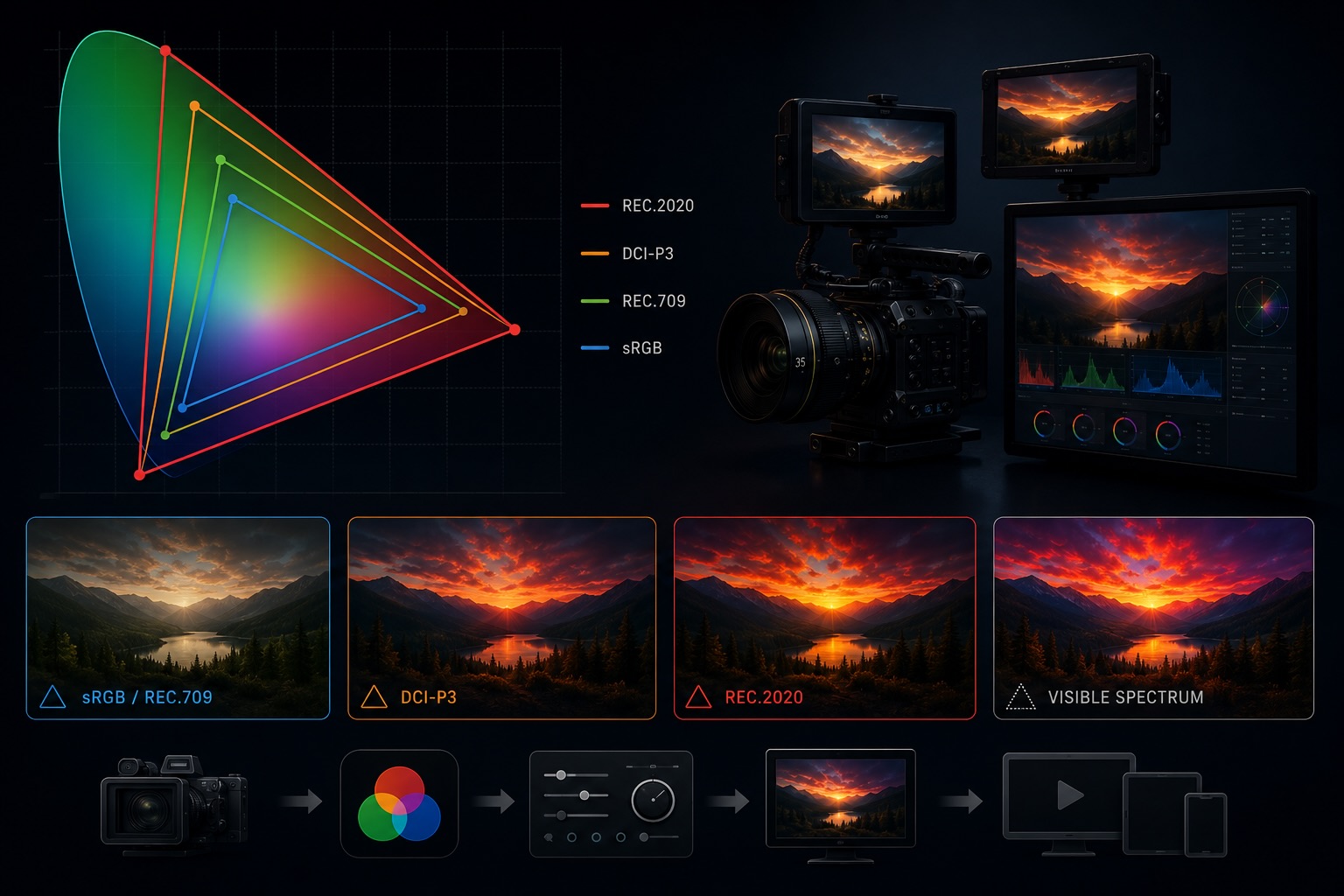
Color Spaces, Explained — sRGB, Rec.709, Rec.2020, and DCI-P3
sRGB, Rec.709, Rec.2020, DCI-P3 — these labels appear on cameras, monitors, and delivery specs, but what do they actually mean? Here's the complete map of video color spaces and why they matter for shooting, grading, and delivery.
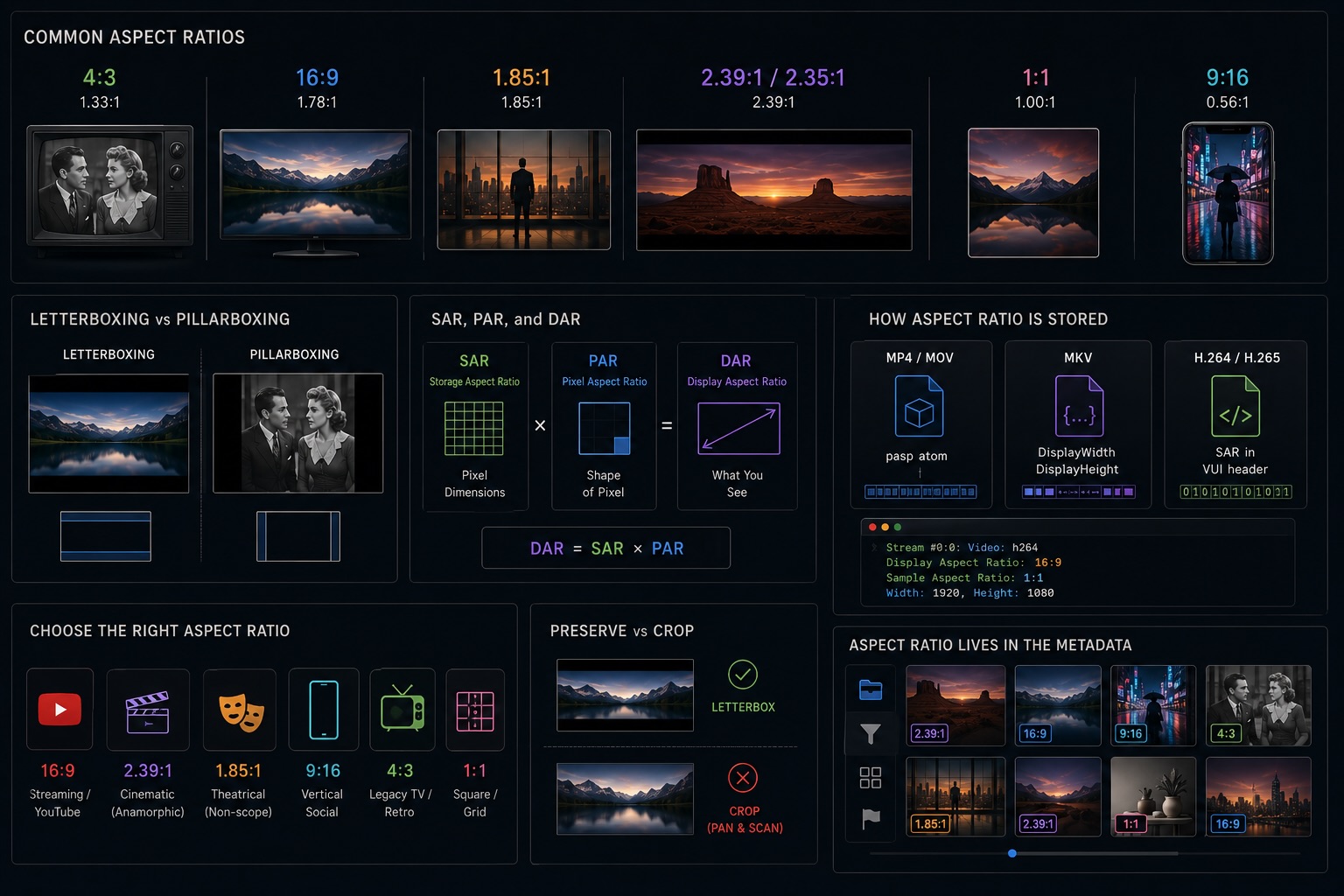
Video Aspect Ratios, Explained — From 4:3 Television to 2.39:1 Anamorphic
16:9, 2.39:1, 9:16, 4:3, 1.85:1 — each ratio carries history, intent, and a specific look. Here's what every common aspect ratio means, where it came from, and how to choose between them.
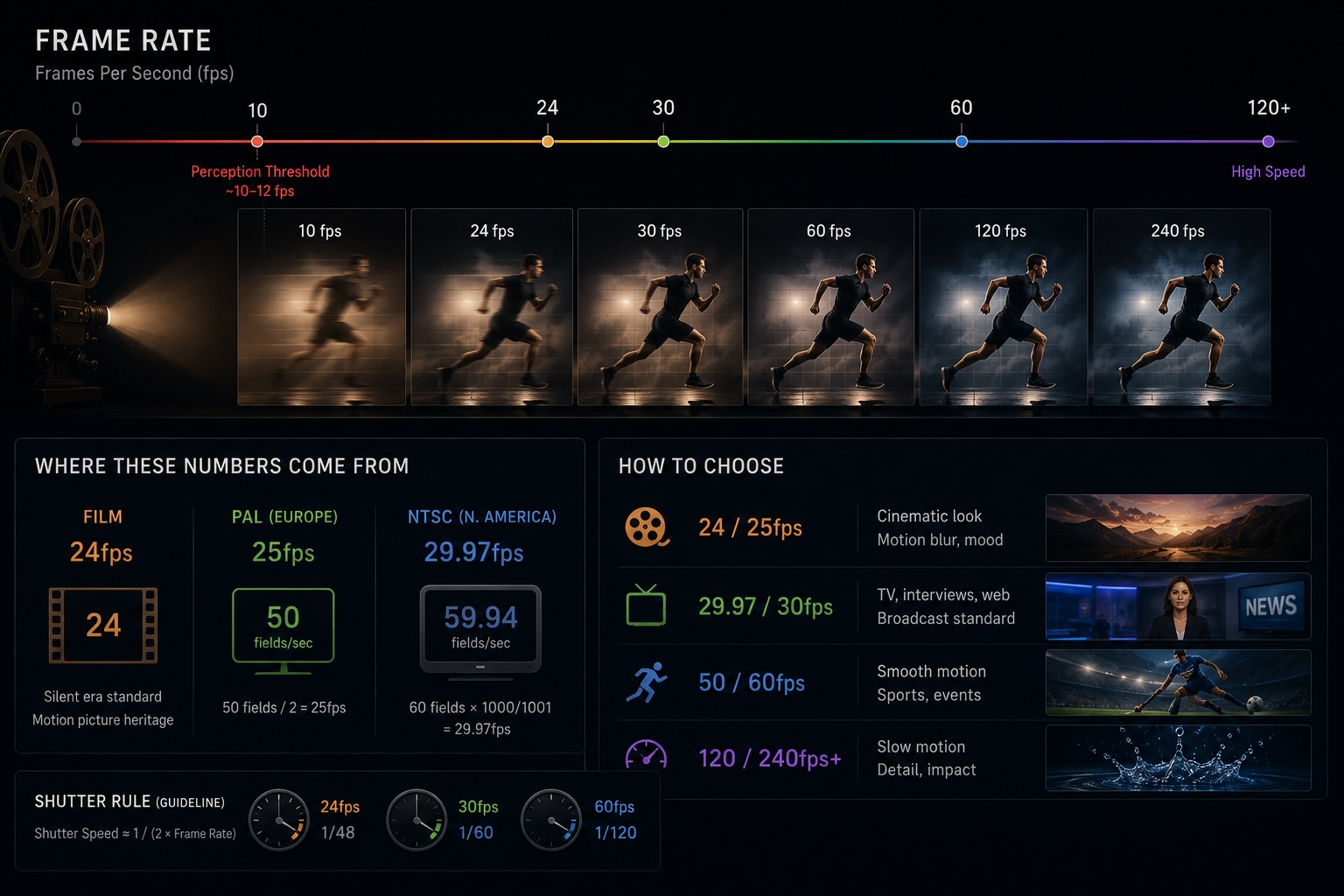
Frame Rate, From the Ground Up — Why 24fps Looks Like Film and 29.97 Has a Decimal
Open the frame rate menu on any camera and you'll see 24 / 25 / 29.97 / 30 / 50 / 59.94 / 60 / 120 / 240 — and no obvious guidance on what to pick. Each number carries history, intent, and a specific feel. Here's the whole map in one sitting.
Shutter Angle, Explained — The 180° Rule and How Motion Feels in Video
You bumped the shutter speed to 1/1000 the way you would for a photo, and now the footage looks stuttery on playback. In video, shutter doesn't control brightness — it controls how motion reads. Here's shutter angle, the 180° rule, and frame rate, in one sitting.
Do Videos Have EXIF? — What's Actually Buried Inside MP4 and MOV Files
You open a JPEG and EXIF tells you the camera, lens, and exposure. Videos seem to give you almost nothing — but the information is in there. Strictly speaking there's no EXIF in a video file, but its equivalents are absolutely present. Here's where to look.
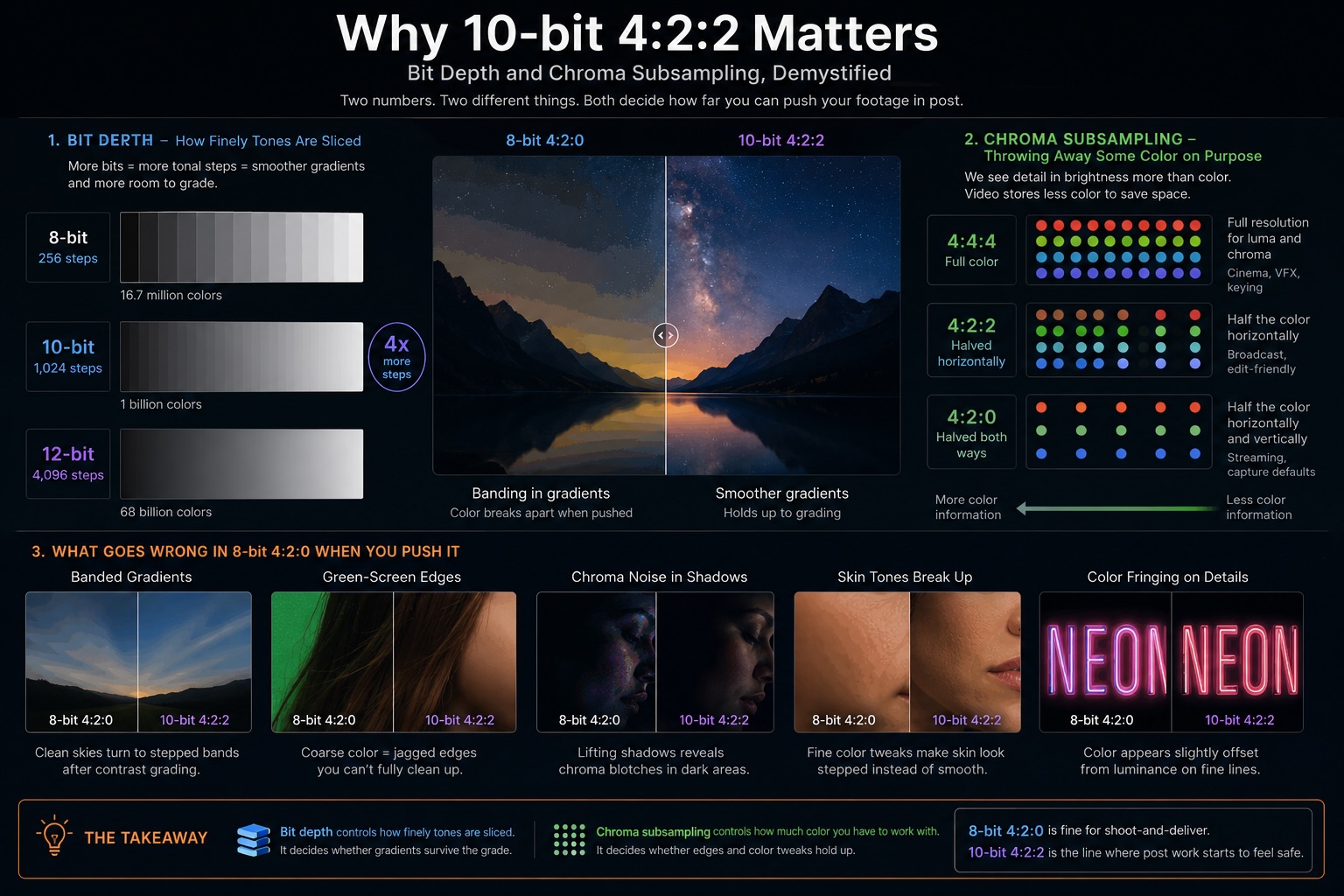
Why 10-bit 4:2:2 Matters — Bit Depth and Chroma Subsampling, Demystified
Everyone tells you to shoot 10-bit 4:2:2, but what does it actually buy you? Here's where those numbers show up in the picture, why they pair with log, and when 8-bit 4:2:0 is still the right call.
Choosing a Video Codec — H.264, H.265, ProRes, and DNxHR in Plain Terms
If you've been exporting everything as H.264 by default, you're leaving choices on the table. Delivery codecs and edit codecs are built for opposite goals — here's how to pick the right one for capture, editing, delivery, and archive.
What Log Footage Actually Is — Making Sense of S-Log, V-Log, and N-Log
Switched to S-Log and ended up with flat, lifeless footage? That's the point. Here's what log gamma is for, what you need around it to make it work, and when not to bother.
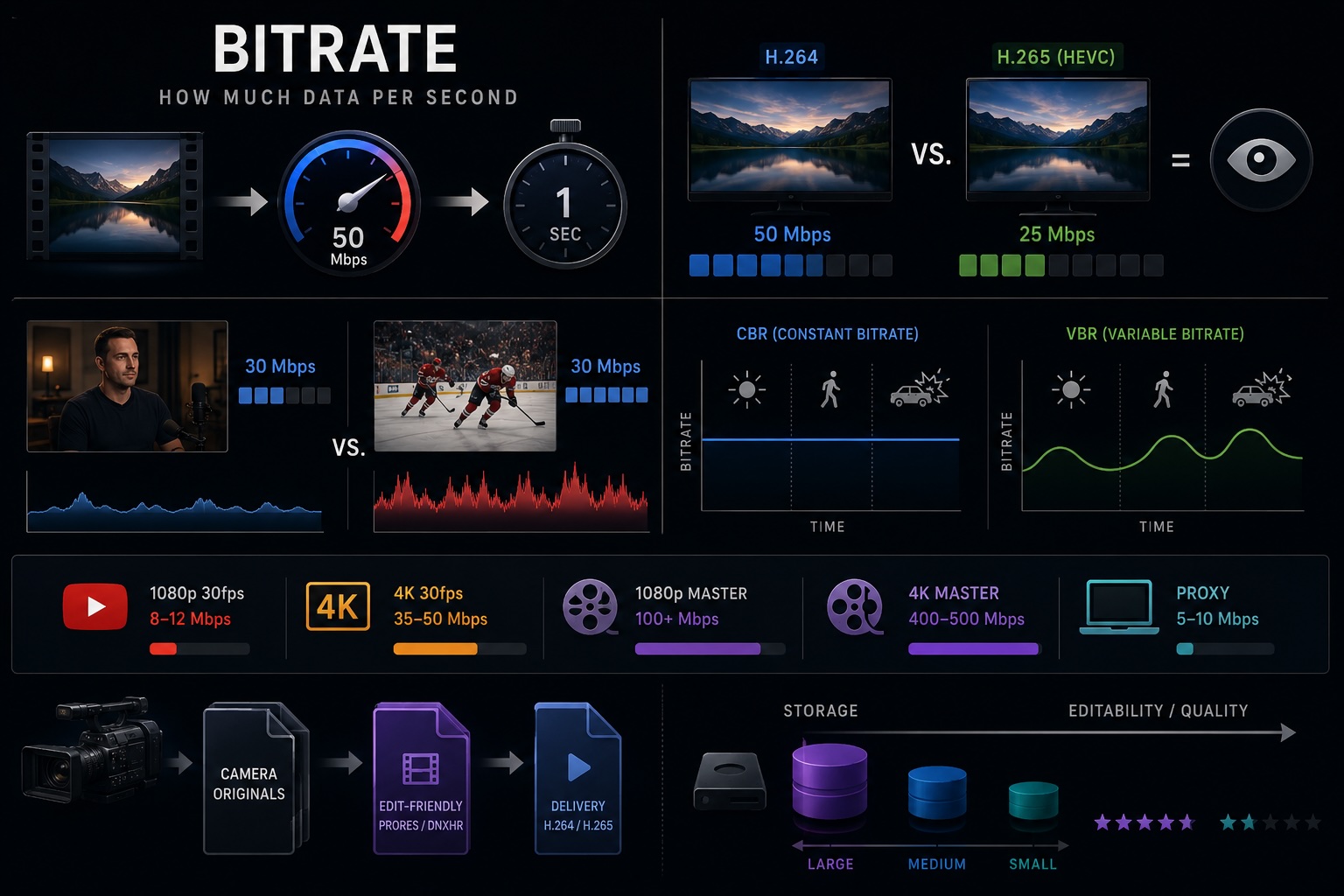
Understanding Video Bitrate — Why the Number Alone Doesn't Tell You the Quality
"Just export at a high bitrate and it'll look great" is only half right. VBR vs CBR, the codec you're using, and realistic numbers for real use cases — here's what bitrate actually controls.